
Studio Visit Pris Roos
Pris Roos is still outside when I call her up one Sunday morning to chat. The video is on, and she stares into the phone with a smile, asking for ten more minutes. When those minutes go by, she is the one to call me back, and the video turns on to show her sitting at her table, a mug of tea (or coffee, I didn’t ask) between her hands.
“Sorry I hadn’t made it back from yoga,” she tells me, her cheeks still rosy from being outside. She laughs and smiles, and any nerves I had about talking to her slip away. “I like to combine it with boxing.” If I didn’t already think she was cool, I definitely do now.
She is sitting in her Rotterdam apartment, the same city where the Dutch-Indonesian artist won last year’s prestigious NN Art award: an initiative celebrating artists educated at Dutch art schools.
“It took me a long time to know what I wanted to do,” says Roos when I ask her about her career trajectory. “It’s crazy that I now get to do this for a living. I actually started studying something completely different at first. Asian business, communication and management.”


It makes sense in a way, that she chose to study what she spent her upbringing doing: working in her family’s toko, an Indonesian name for a small shop selling a variety of goods.
“I was always drawing as a child, I used to make comics. I loved to read them myself, especially detective comics. I loved to solve mysteries. At around 12-13 I stopped drawing. I had other things to think about: puberty, groceries, shop stuff.”
The place that ironically kept her too busy to draw and pursue art is what she now uses as a vital inspiration source. She still works there twice a week, and the eclectic mix of people that walk through those doors bring with them so many stories and new perspectives that she loves to capture in her work.
“Unfortunately, I don’t have any of my early drawings anymore. There was a fire in our family home that destroyed everything”.


I ask her how she found her way back to making art, how it came to be that she is now making a name for herself as one of the most upcoming artists in the Netherlands, with several upcoming exhibitions in store.
“I did a course in multimedia design where I learned how to use Illustrator, Photoshop, etc, so I was being creative in that sense. I ended up in a marketing role where I had to make storyboards, but I decided to draw them all by hand. That’s when I reconnected with drawing and wanted to continue exploring artistically.”
She tells me about learning the basics during her part-time BA at the Royal Academy of Fine arts in the Hague. “I was one of the youngest in the program, and it was quite an intimidating atmosphere. There were already people there with a successful art career. You end up competing with others and seeking the approval of the teachers. It was quite subjective and old-fashioned, but then again, there are traditions in painting that you have to abide by”.
“I experimented with a lot of textures and techniques, there was a lot of DIY. I started using whatever I could find, that’s where I began to work on cardboard. I tried to recreate a lot of the art I admired. I especially loved MC Escher’s graphic art. That was before I really used colour in my work.”
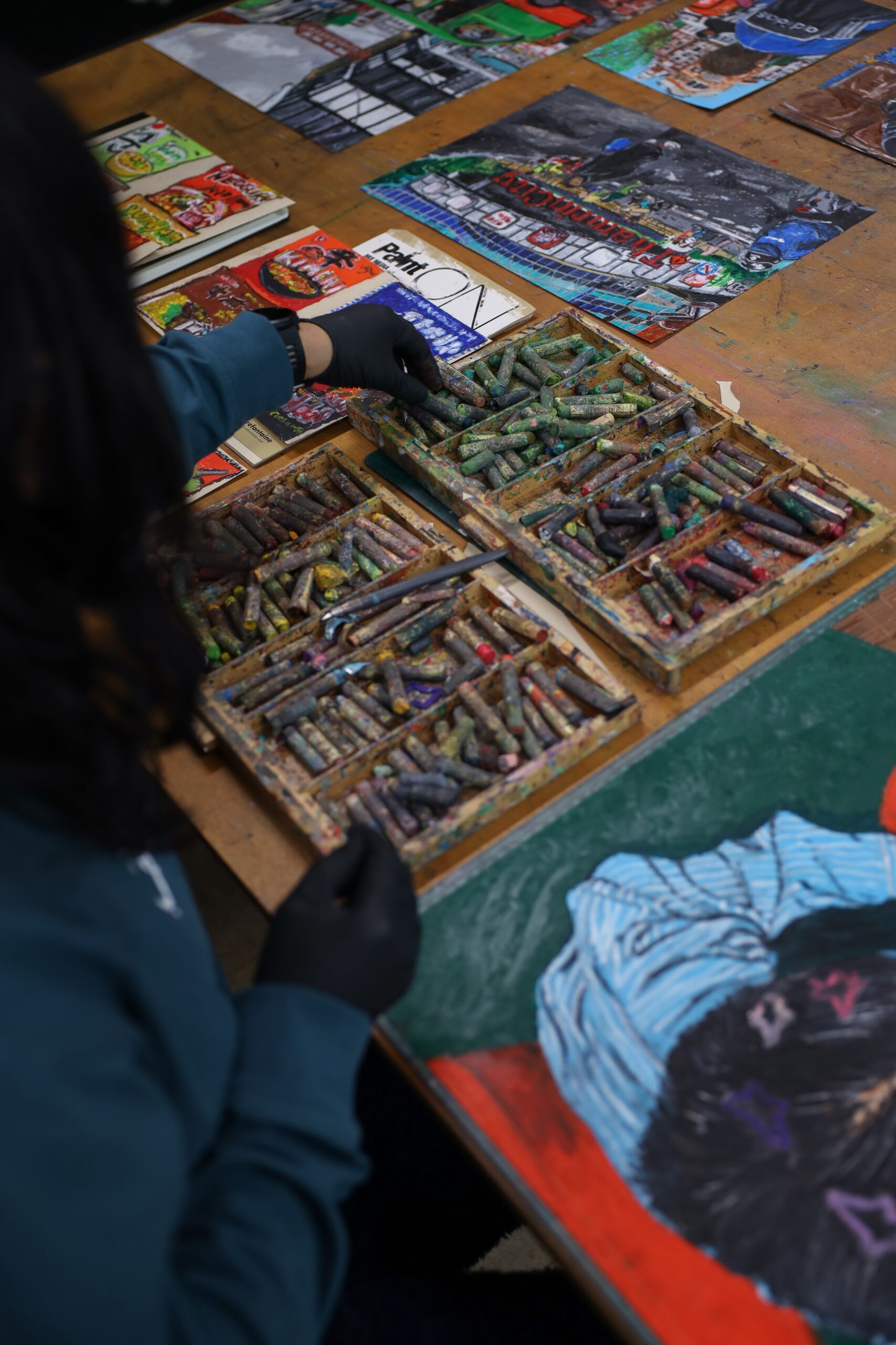

We talk more about Roos’ Erasmus semester in Bremen, Germany, where she began figurative painting, and then her Fine Art MA in Hamburg. On the topic of moving abroad, I ask her how a shift away from the place you call home impacts your identity, and ultimately the art you create.
“I’ve decided I want to be an international artist, so living in Indonesia has become more important to me. I am going to try it out soon. I want to have a studio over there, up in the mountains, as well as here, and then come back and forth.”
I’m jealous that she gets to escape the rain and misery of Northern European winters, and I say this out loud, knowing that this obviously is a choice that runs deeper than the weather. “My parents came here to have a better life, and yet Indonesia is where Dutch people go on holiday. They go there to escape the rain. I find that dynamic quite interesting.”
The topic of migration, cultural memory, and belonging is ripe in Roos’ works, and made even more powerful by her portrayal of everyday life. The themes are subtle, blending into the background to bring her subjects’ stories to life. In other words, these topics aren’t made into a spectacle, but instead remain as a simple truth.


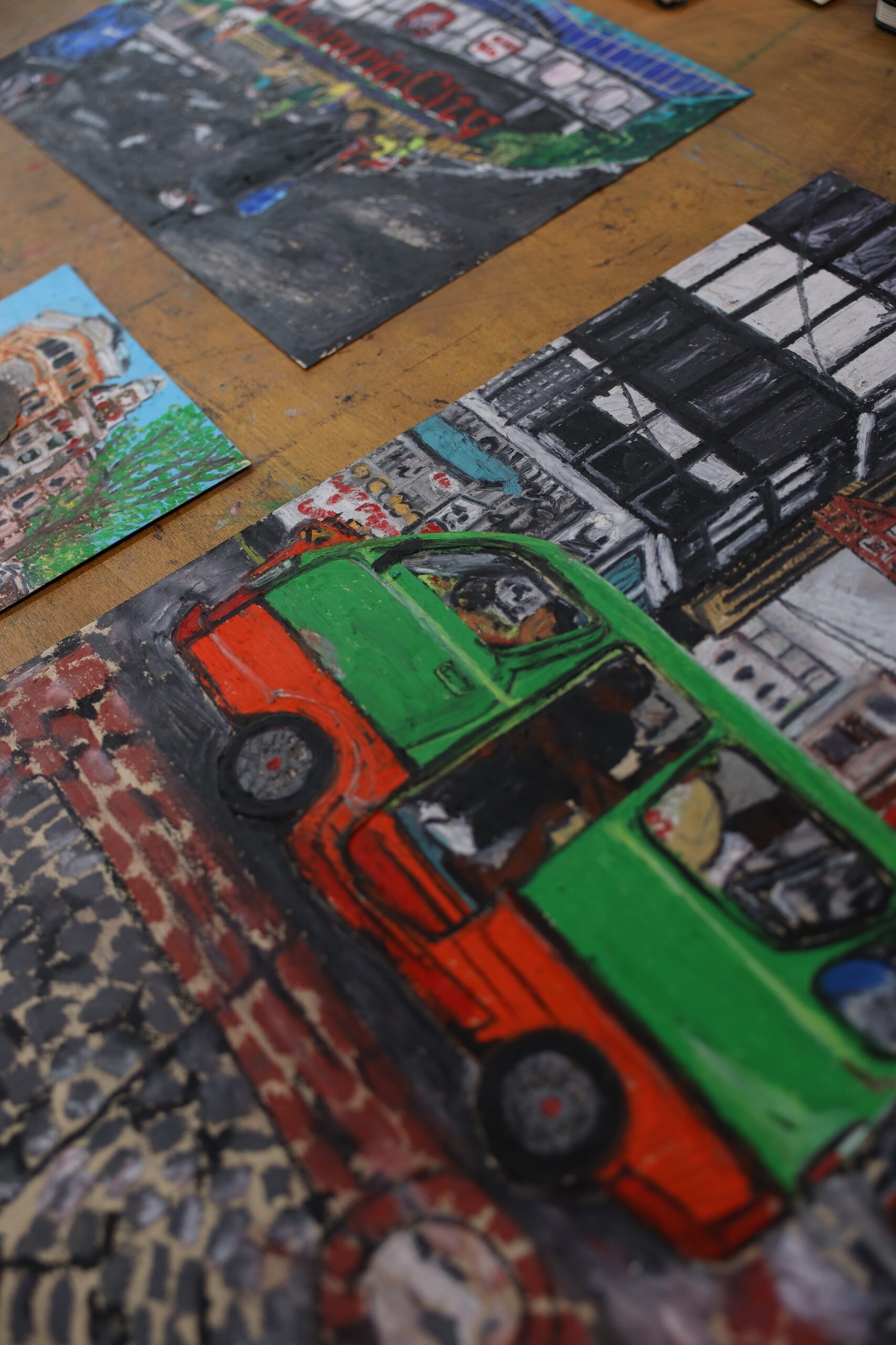
“I love to travel, and that comes across in my art. I am interested in the history of a building, especially when I see one under reconstruction. I feel like I’m witnessing the in-between, and street art is the memento of the switch. For example, my drawings of Manchester show buildings with graffiti on them, which have now been renovated. The graffiti is no longer there, and was probably only there for a short time, but now it lives forever in my drawings. I also draw shops, which are another indicator of how time changes things. The shops that are still open (so successful in that sense) are a testament to what the people want at a certain time and place. I find that fascinating.”
This year Mini Galerie returns to Art Rotterdam with a new collection of Roos’ works: “The works are about my time in different cities and about friendships. I like to take loads of photographs of people on the streets while I am away. These are memories from my time in Bogor and Jakarta in Indonesia and in Amsterdam, together with memories from when I am home again. Those memories are mostly of my friends; A friend reading, my close ones braiding each other’s hair.”

Other than making art, Roos tells me about her other passion project: Hoffie, the travelling children’s library she set up, a realization of a childhood dream. A collection of children’s books written by people of colour, the idea is to cover important themes about gender, sexuality, and sustainability, from a variety of perspectives. The library then moves around the country, hopefully increasing in size along the way as more books get added. Currently the collection is at a high school in Rotterdam. Soon, Roos will be able to add her own book, “De Toko van Mijn Ouders”, a publication of drawings from the world of her parent’s toko.
I thank Roos for her time and hang up the phone. It’s obvious that people feel comfortable being featured in her drawings because of her warmth and friendliness, but her ability to share details of her life with honesty and humour is what makes her and her art stand out. Despite coming from different backgrounds and cultures, Roos’ art resonates in the fact that it is grounded in humanity.
Upcoming exhibitions of Pris’ work include Art Rotterdam (represented by Mini Galerie) from the 27th-29th March, “Welcome to the World of the Tjong-Khing!”, a group exhibition at the CODA museum in Apeldoorn April 19th – October 25th, “Toko Limburg” at Limburg Museum May 16th-2nd January 2027, and “Unfair”, a three day group exhibition from 17th-20th September.
Text by Alicia Hansen
Photography by Chloë Alyshea

